I’ve trained enough people to know that most gym advice misses the point.
You start strong. You follow the plan. Then something shifts and you’re back where you started, wondering why it didn’t stick.
Here’s the truth: the problem isn’t your effort. It’s that most gym tips focus on what to do without explaining how to make it last.
fntkgym gym tips by fitnesstalk exists because sustainable fitness requires a different approach. Not harder workouts. Smarter preparation.
I’m going to show you how athletes think about training. The mental side. The preparation that happens before you even walk into the gym. The small shifts that build real momentum.
This isn’t about crushing yourself with brutal routines. It’s about building a foundation that actually holds up when life gets messy.
The tips here come from principles used to train competitive athletes. We’re talking about performance psychology, strategic prep work, and the kind of foundational strength that carries over into everything you do.
You want actionable advice that keeps you healthy and fit for years, not just weeks. That’s what you’re getting.
No fluff. No motivational speeches that fade by Tuesday.
Just a framework that turns gym time into something that actually works long term.
Master the Foundations: Your Core for Lasting Fitness
Walk into any gym and you’ll see it.
Someone loading up the squat rack with way too much weight. Their knees cave in. Their back rounds like a scared cat. And you just know tomorrow’s going to hurt.
I’ve been that person. (Not my proudest moment, but we all start somewhere.)
Here’s what nobody tells you when you’re starting out. The fancy stuff doesn’t matter. The Instagram-worthy exercises? They’re not what builds real strength.
You need the basics. The boring, unglamorous movements that actually work.
Why Compound Movements Are Your Best Friend
Squats. Deadlifts. Bench presses.
These aren’t just exercises. They’re the foundation of everything else you’ll do in the gym.
Think about it. A squat doesn’t just work your legs. It fires up your core, your back, your entire posterior chain. You’re getting multiple muscle groups working together, which means more calories burned and a bigger hormonal response.
Your body releases more growth hormone and testosterone when you do these big movements. (Yes, even for women. You need testosterone too, just not as much.)
That’s why I tell people to build their workouts around compound movements first. Everything else is just extra credit.
Some trainers will say you need variety to keep your muscles guessing. Sure, variety has its place. But if you’re skipping squats to do leg extensions on a fancy machine? You’re leaving results on the table.
Form Over Ego Every Single Time
I know the temptation.
You see someone benching 225 and you think, “I should be doing that.” So you load up the bar and immediately your shoulders start doing this weird chicken wing thing.
Stop. Just stop.
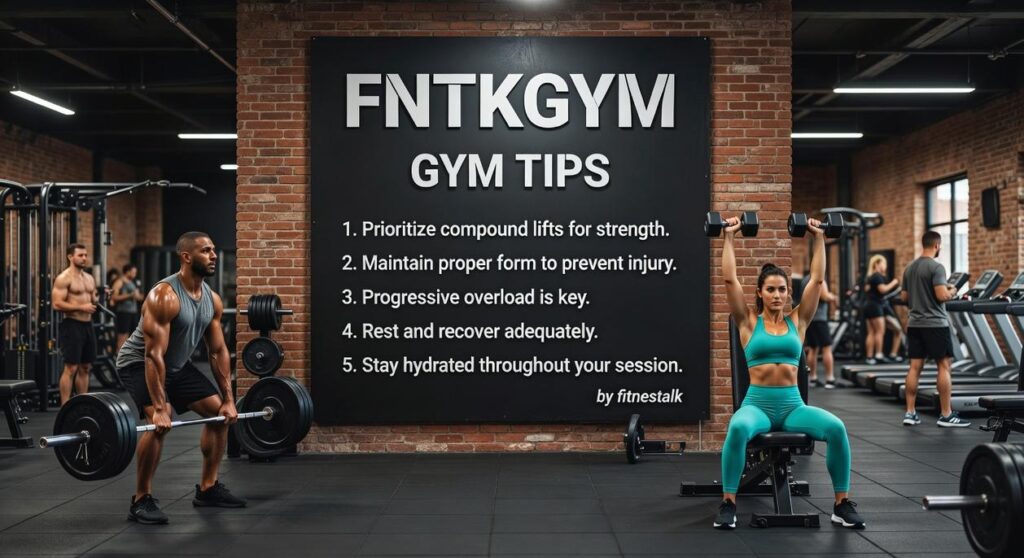
Perfect form beats heavy weight every time. And I mean every time.
Poor form doesn’t just risk injury. It actually makes the exercise less effective. You end up using momentum and other muscles to compensate, which means the muscle you’re trying to work doesn’t get the stimulus it needs.
Start light. Master the pattern. Then add weight.
I spent three months doing goblet squats with just a 25-pound dumbbell before I even touched a barbell. My ego hated it. My knees thanked me later.
Here’s a fntkgym gym tips by fitnesstalk that changed how I approach training: film yourself. Your phone has a camera. Use it. What feels like perfect form often looks completely different on video. Incorporating the Fntkgym tip of filming your workouts has transformed my training routine, revealing discrepancies in my form that I never would have noticed otherwise. Incorporating the Fntkgym principle of filming my workouts has not only enhanced my technique but also provided valuable insights into my progress that I would have otherwise missed.
Progressive Overload Is the Only Way Forward
You can’t do the same workout forever and expect different results.
Your body adapts. That’s literally what getting stronger means. Your muscles figure out how to handle the stress you’re putting on them.
So you need to keep challenging them. That’s progressive overload in a nutshell.
It doesn’t mean adding weight every single session. (That’s a fast track to burnout or injury.) It means finding ways to make the work harder over time.
Add 5 pounds to the bar. Do one more rep. Take 10 seconds off your rest time. All of these count.
Last month I was doing 3 sets of 8 reps on my squat. This month I’m doing 3 sets of 10 with the same weight. Next month? Maybe I add 10 pounds and drop back to 8 reps.
The pros and cons of weight training Fntkgym approach shows that consistent progression beats random intensity every time.
Some people argue that you should train to failure every set to maximize growth. And look, training to failure has its place. But doing it constantly? That’s how you fry your nervous system and stop making progress.
I’d rather see you add one rep per week than burn out chasing failure every workout.
The foundation isn’t complicated. It’s just not easy. Big movements, good form, steady progress.
That’s it. That’s the whole game.
Harnessing ‘Momentum Moments’ to Stay Consistent
You know that feeling when everything clicks?
When the workout feels good and you leave the gym thinking “I could do this forever.”
That’s a momentum moment. And honestly, it’s the secret to staying consistent when motivation runs dry.
Most people wait for these moments to happen by accident. I’m telling you to create them on purpose.
Start by identifying what your momentum moment actually is. For some people it’s hitting a new PR. For others it’s just showing up on a day when the couch felt more appealing than the squat rack (and let’s be real, that happens to all of us).
The point is to recognize what makes you feel like you’re winning. Because that feeling? It compounds.
Now here’s where most advice falls apart. People tell you to set big goals and work backward. But when you’re struggling to stay consistent, “get fit” or “lose 30 pounds” feels like staring up at a mountain.
I recommend breaking everything down into micro-goals instead. Think weekly targets that you can actually hit. Complete three workouts this week. Add 5 lbs to your squat. Hold a plank for 10 seconds longer than last time.
These aren’t participation trophies. They’re real progress in bite-sized pieces.
At fntkgym, we see people transform when they stop chasing perfection and start stacking small wins. It’s not flashy but it works.
Here’s something else I want you to try. Pick one workout right now and label it your reset button. Make it something you genuinely enjoy. Something that doesn’t intimidate you or require peak energy.
Maybe it’s a 20-minute walk with your favorite podcast. Maybe it’s some light kettlebell work or bodyweight circuits in your living room.
When life knocks you off track (and it will), this is what you do to get back in. No guilt. No pressure to go full intensity. Just movement that reminds your body what consistency feels like.
I’ve watched people beat themselves up for missing a week, then avoid the gym for another month because they feel like they need to make up for lost time with some punishing session.
That’s backward thinking. The ideas here carry over into Gymansium Guide Fntkgym, which is worth reading next.
Your reset workout is permission to start again without the drama. Use it.
Elite Strategies for Peak Athletic Performance

I’ll never forget watching a client struggle through bicep curls.
He was doing everything right on paper. Good form. Proper weight. But his arms weren’t growing.
So I asked him a simple question: “What are you thinking about right now?”
He said he was thinking about what to eat for dinner.
That’s when it clicked for me. His body was going through the motions but his brain wasn’t in it.
Mind-Muscle Connection: This isn’t just ‘bro science.’
When you actually think about the muscle you’re working, something changes. Research shows that focused attention during exercise improves muscle activation by up to 60% (Calatayud et al., 2016). Understanding the intricate dynamics of muscle activation not only enhances your workout but also adds depth to the ongoing debate of Cardio vs Weight Training Fntkgym, as focusing your mind on the specific muscles being engaged can significantly boost your results. By exploring the nuances of muscle activation during workouts, enthusiasts can better appreciate the ongoing debate surrounding Cardio vs Weight Training Fntkgym, ultimately leading to more effective training regimens.
Here’s what I tell people at the gym. Pick one exercise and really focus on it. Feel the muscle contract. Pause for a full second at peak contraction.
Try it on your next set of rows. Think about your back pulling the weight, not your arms. You’ll feel the difference immediately.
Strategic Rest and Recovery
Some people think more is always better.
They train six days a week and wonder why they feel like garbage. (I used to be one of them.)
Your muscles don’t grow in the gym. They grow when you sleep. When you eat. When you rest.
I learned this the hard way after pushing through fatigue for months. My lifts stalled. I felt tired all the time. Then I added deload weeks where I cut volume by 40% every fourth week.
Everything changed. My strength shot up. I felt better. The fntkgym gym tips by fitnesstalk approach emphasizes this: recovery is part of the work, not a break from it.
Vary Your Training Stimulus
Doing the same workout for months feels comfortable.
It also stops working.
Your body adapts fast. What challenged you eight weeks ago doesn’t challenge you now. This is why periodization matters. You need to change the stimulus.
I’m not saying reinvent your whole program every week. Just make small shifts. Swap your rep ranges from 8-10 to 12-15 for a month. Change exercise order. Add a pause rep variation.
These small changes keep your body guessing and your progress moving forward.
Game Day Ready: Prepping Your Body for Peak Output
You can’t just walk into the gym cold and expect your body to perform.
I see it all the time. People roll up, grab some weights, and wonder why their first few sets feel terrible.
Here’s what actually works.
Eat smart before you train. I’m talking about a simple meal with complex carbs and protein about 60 to 90 minutes before you hit the gym. Think oatmeal with some eggs or a chicken sandwich on whole grain bread. Nothing fancy.
This gives your body time to digest and convert that food into usable energy. You’ll feel the difference when you’re halfway through your workout and still have gas in the tank.
Now let’s talk about warming up.
Some people say static stretching before lifting is fine. That holding a hamstring stretch for 30 seconds gets you ready to move heavy weight.
They’re wrong.
Static stretching before a workout actually decreases your power output (according to research from the Journal of Strength and Conditioning Research). Your muscles need activation, not relaxation.
Go dynamic instead. Leg swings, arm circles, bodyweight squats. These movements wake up your nervous system and prepare your muscles for what’s coming. I spend five minutes on this every single session, and it’s changed how my body responds to cardio vs weight training fntkgym routines.
Here’s something most people skip entirely.
Mental prep matters. Before a heavy lift, take 60 seconds to visualize yourself executing perfect form. See yourself completing the rep with control and power.
It sounds simple (maybe even silly), but this fntkgym gym tips by fitnesstalk approach primes your brain for success. Your mind rehearses the movement before your body attempts it. Understanding the Pros and Cons of Weight Training Fntkgym can significantly enhance your mental preparation, allowing your mind to visualize each movement effectively before you even step onto the gym floor. Understanding the Pros and Cons of Weight Training Fntkgym is essential not only for maximizing your physical gains but also for enhancing your mental focus and confidence in the gym.
Think of it like a dress rehearsal before the main event.
Your body follows where your mind leads. Pre Workout Supplements Fntkgym picks up right where this leaves off.
Build Your Fitness, Own Your Momentum
You came here looking for fntkgym gym tips by fitnesstalk that actually work.
Not another list of exercises you’ll forget tomorrow. Not motivational fluff that fades by Tuesday.
You wanted real strategies to stay consistent and push past those frustrating plateaus.
Now you have them.
The difference between people who quit and people who keep showing up comes down to systems. When you focus on solid foundations and build real momentum, working out stops feeling like a battle you’re losing.
Preparing like an athlete changes everything. It turns random gym sessions into a practice that compounds over time.
Here’s what I want you to do: Pick one strategy from this guide. Maybe it’s identifying your momentum moment or maybe it’s perfecting your warm-up routine.
Apply it during your very next gym session.
Not next week. Not when you feel more motivated.
Tomorrow.
That’s how you turn information into results. You take one piece and you use it.
The gym doesn’t get easier but you get stronger. Your system gets tighter. Your momentum builds.
Start with one change and watch what happens.
 There is a specific skill involved in explaining something clearly — one that is completely separate from actually knowing the subject. Veslina Xelthorne has both. They has spent years working with strength training techniques in a hands-on capacity, and an equal amount of time figuring out how to translate that experience into writing that people with different backgrounds can actually absorb and use.
Veslina tends to approach complex subjects — Strength Training Techniques, Athletic Conditioning Tactics, Momentum Moments being good examples — by starting with what the reader already knows, then building outward from there rather than dropping them in the deep end. It sounds like a small thing. In practice it makes a significant difference in whether someone finishes the article or abandons it halfway through. They is also good at knowing when to stop — a surprisingly underrated skill. Some writers bury useful information under so many caveats and qualifications that the point disappears. Veslina knows where the point is and gets there without too many detours.
The practical effect of all this is that people who read Veslina's work tend to come away actually capable of doing something with it. Not just vaguely informed — actually capable. For a writer working in strength training techniques, that is probably the best possible outcome, and it's the standard Veslina holds they's own work to.
There is a specific skill involved in explaining something clearly — one that is completely separate from actually knowing the subject. Veslina Xelthorne has both. They has spent years working with strength training techniques in a hands-on capacity, and an equal amount of time figuring out how to translate that experience into writing that people with different backgrounds can actually absorb and use.
Veslina tends to approach complex subjects — Strength Training Techniques, Athletic Conditioning Tactics, Momentum Moments being good examples — by starting with what the reader already knows, then building outward from there rather than dropping them in the deep end. It sounds like a small thing. In practice it makes a significant difference in whether someone finishes the article or abandons it halfway through. They is also good at knowing when to stop — a surprisingly underrated skill. Some writers bury useful information under so many caveats and qualifications that the point disappears. Veslina knows where the point is and gets there without too many detours.
The practical effect of all this is that people who read Veslina's work tend to come away actually capable of doing something with it. Not just vaguely informed — actually capable. For a writer working in strength training techniques, that is probably the best possible outcome, and it's the standard Veslina holds they's own work to.